A lot of data comes from non-IT companies like automobiles, manufacturing etc.
Have a holistic idea how business can appreciate technology and how we can apply technology.
Growth drivers
Roles and responsibility of the production manager: Session 2
Introduction to manufacturing
Different manufacturing system
Giving back to the society: social responsibility
How can the industrial revolution be looked from industrial perspective?
Enhance the top-line growth to environmental factors to social factors.
Sustainable smart city, conservation of water.
17 sustainable goals as global ambition 2013 by UN.
How relevant are today’s systems.
Production, planning and control (PPC). What function does PPC have?
Work order, loading an scheduling, dispatching
Have data centric point, what data can be collected. What type of data can be collected?
Process owner: Can be anyone general manager and supervisor.
Every shop-floor is capturing and manufacturing data. Dara is becoming voluminous.
Real time analytics, operational analytics, analytics and manufacturing (technology disruption: Mc Kinsey article)
Relevance of iOT in manufacturing.
Kanban, D
Agile: enhance in information flow. It is along with lean. It helps churn data and helps bring out information data. The entire business is working on data. Mercedes benz C class. They know when truck will arrive better than truck.
Lean: enhancement in reduces waste, elements that contribute to waste, optimising waste
Research domain, how to practise leaness. Adman Swami. His first video. Shedding the unrequired weight in the body: most sophisticated body in the world.
Supply chain: definition, extended, straight look from vendors vendor to customer customers.
Technology backup: can blockchain enhance the supply and operations enhancement.
Reverse supply chain
Supply chain operation reference: How important the model is for the matrix to be practised and achieved across the entire
SCOR model: efficiency and effectiveness of supply chain model.
Warehouse management: material management from warehouse to factory, warehouse to retail.
Case study: disruptive technology.
How robotic process automation, how advanced process of robotic process automation is.
3D printing: Dubai has the largest machine.
Micheal Porter: how augmented reality is important for shop-floor.
Harvard Business review. Augmented reality app.
Increasing youth population, middle class is going to have global consumption
Skill india
Competitive advantage India is a nation but still it lags behinds.
Strategies adopted by Indian manufacturing sectors to be
IOT. Robotics, blockchain are trying to disrupt already existing technologies.
Value added: direct lost, variable cost, labour cost. From raw material to finished product.
GDP of India: 2.94 trillion dollars
Gross value added at factor cost+ production taxes-production subsidies.
What is a subsidy: the cost is charged free of cost.
Export =1.7 times imports
GVA at market prices,
IIP: mining, manufacturing
77.63% manufacturing (central statistics office)
Predictive Analytics
Smart, connected products (IoT)
Advanced materials
Smart factories
Digital design, simulation and integration
High performance computing
Advanced robotics
Addictive manufacturing(3D printing)
Open source design/direct consumer input
Augmented reality (to improve quality, training, expert knowledge)
Augmented reality (to increase customer service & experience)
See: Deloitte Touché tohmatsu limited and Us council on competitiveness.
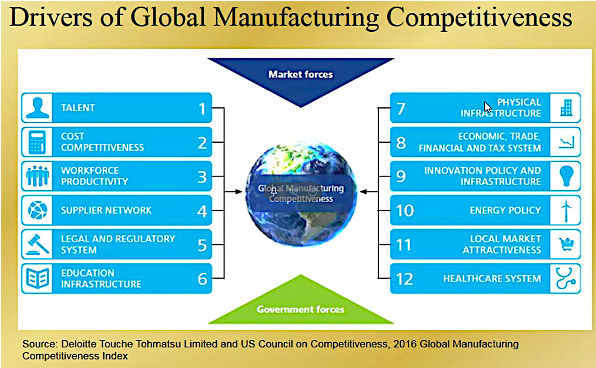
Drivers of global manufacturing competitiveness
Competitive advantage : Expectations of the customer.
Can we expect major disruption in core competitiveness. Cost leadership with the service, work force, supply chain, legal system.
Strategies by Indian manufacturing
Collaboration, digital technologies, focus backward integration, focus on
| Digital technologies | India is one of the strongest in automobile truck manufacturing |
| Focus on backward integration | Helps manufactures to increase efficiency without sacrificing. McDonald contact suppliers that nationally. They make sure the quality is same pan india. Where does cheese come from. It comes from vendors. They are strictly controlled. Some vendors only supply to vendors as long as they give same quality and quantity. Coke is known for both backward and forward. The entire process of input and output is managed by coke. Toyota has complete accountability of the products. How many has to made available a retail stores at various places. They have absolute control. Maruti suzuki manages the entire supply part then only manufacturing and services will go hand in hand. |
| Focus on forward integration | Forward integration strategies also help organisation to realise cost benefits. |
| Collaboration |
Backward and forward is for stabilised business it depends on the capabilities. It is application for medium, small enterprises. The established brands are able to integrate both backend and for end.
Haldiram is able to. Alloo
Make in India
It launched in 2014. They are integrating with Japan and Korea. India became top destination globally for FDI in 2015.
Skill India
It was launched in 2015 which aims over 400 million people in various skills. It involves various schemes.
Startup India
Opportunities for Manufacturing
| Government initiative | Tell usIntroducing on I wA | |
| Defence manufacturing | ||
| Electronics goods manufacturing |
Manufacturing is very closely related to engineering and design.
It also being
The 5 M in manufacturing is :
- Man : white colllared and blue collared work in shop flood. Blue
- Money : In the form of raw materials, working progress.
- Machines :
- Materials :
- Methods :
Operation gives an end to end visibility. What happens the shop floor and what happens after the shop floor. It makes one more agile.
Operations Analytics.
Instances of wastes in conversion process :
- Higher conversion costs : (higher costs resulting from inefficient methods, poor quality of tools, bad conditions of machines, wrong selection of materials, poorly trained operators, ineffective supervision). Wrong calibrated equipment. The market fixed the selling price.
Objective of management
Efficiency : Maximising utilisation of manpower, machines, etc.
What are different examples of operations :
Manufacturing and services : Services are commodised. They are indespicible with each other.
Logistics and supply chain.
Tourist companies provide services in unique and different ways.
In canteens,
Kitchen (shop floor) is where the conversion takes place. Before the kitchen there needs to be various things like procurement, loading and storage, making infrastructure available, quality check on materials.
Classification of the manufacturing system
Types of production :
Intermittent : Several different products on the same production line and continous.
Intermittent Manufacturing System
25 min past, 5th September
Features :
Continuous flow of materials
Special purpose machines and product layout
Mechanised material handling
Skilled and semi-skilled labours : Semi skilled won’t be direct conversion, they will support activities like maintenance, procurement.
Short manufacturing cycle time
Easy supervision
Limited WIP : Working process in car production or refrigerators. Different assemblies at different parts.
Less flexibility in production scheduling
Production : production of a single item conducted for an infinite period of time.
(Sugar, steel, cement, paper, refineries, etc)
3a presentation : Manufacturing system, types,
Batch production : intermittent
Why are some airlines profitable while some aren’t?
20 marks multiple choice quiz.
YS4 Hana a Street it is a very high analytically
If you are developing a built memories 10 REDDIT is preferred. Hazelcast preferred.
Vishal Sikha.
The amount of structure data is 3 to 4 point times the unstructured data. Do a complete data life-cycle what is managed through backend which was called in memory database. Even clouds 10 to 15 years old now over the last 50 indicates we find out that evolution of cloud is just amazing. There is nothing cloud can provide as a service. We have looked at loud as infrastructure as a service, the service as a service, platform as a service know everything as a service. In a WS everything is provided and there is nothing Client can consume from AWS.
Cloud has become see a child and most comparison kind of solution. SBP came from Just enterprise resource planning to customer support, to digital intelligence, customer relationship management and many new solutions added up what. The fourth generation customer services.
These days every companies who did not even imagine they will be on the cloud, are on the cloud.
Enablement meant of analytics on the cloud, how can clients consume high-end Analytics from the cloud be it Microsoft as your or Amazon or Google. Library available in R is already available in SAP predictive analytics.
A company like Tata motors which is Indus there for half a century, cloud came not 50 years ago it came just 15 years ago over a period of time and over last five years we find cloud getting much faster awareness and acceptance and maturity. New start-ups, new business models, companies which are working on disruptive innovative product on a very small products can have the entire business of the cloud. So they are moving from on premise to on cloud.
What is business problem integration?
Sankara is is Asian of a company’s internal operations with those of its other divisions and its trading partners by connecting disparate systems in real time.
What are the key what are the technologies used to run these processes. Within the department are all these processes integrated? Does any of these process start from your department through several other departments if it is like that then today’s technology enablement enables one to not only integrate departments processes but also when it runs through other department processes.
When it comes to medical supplying it comes to bulk order.
Business process integration tries to find such organisation tries to integrate and then for visually for the whole organisation and to the trading partners that is customer and suppliers on the both side.
Why should business problems integrated?
BPI allows automation of business processes, integration of systems and services, and secure sharing of data across numerous applications.
Overcoming integration challenges allow organisations to connect systems internally and externally.
BPI allows for the automation of management, operational, and supporting processes.
Today, businesses of size needs officiant integration solution to streamline processes between marketing, sales, customer service and supply chain management, etc.
integration among administrative, operational and support processes increases productivity by simplifying regular enterprise functions. Operation will be production, sales distribution, procurement, HR support functions. There can be 4 different plants at different locations. Organisation structure found the skeleton of a company.
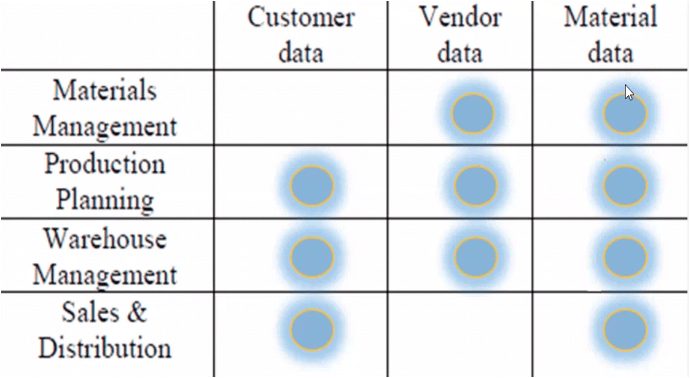
Master data: has customer, vendor and material. Production planning involves all the data of customer, vendor and material. The customer will give the forecast demand of the materials needed. In warehouse management it will include all the date of customer, vendor and material. Sales and distribution data just interested in customer data and material data. They just want finished data and not ROMaterial. ituation in Data talks about who, when and where. Who is actually doing the transaction, when is it when is action happening and where is the transaction happening. Purchase order is a transactional order it has date, it has prices, quantity, has delivery date, etc. Vendor and material is used to create a purchase order.
Transaction documents: invoices, purchase orders and packaging list.
Plant maintenance will need to interact with procurement because they might might need to have some spare parts.
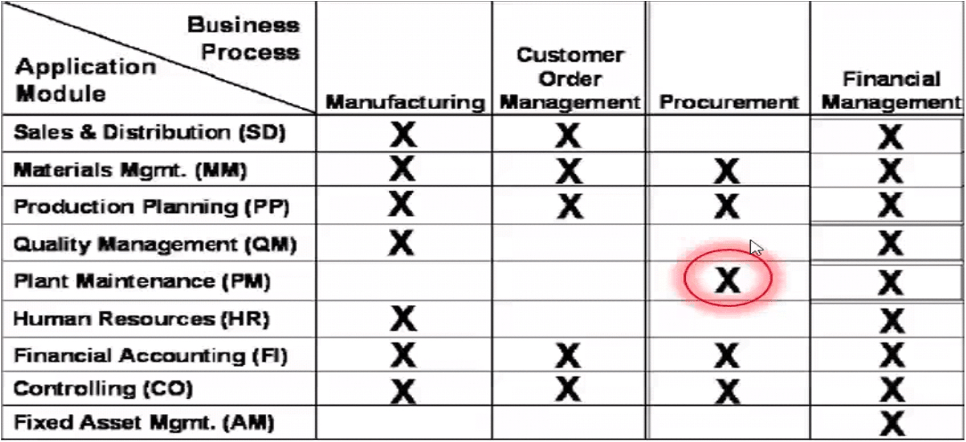
What all departments need to be integrated?
But how much to make you should know how much to buy for that one needs to know how much there is in stock so there needs to be an integration.
Your P data integration – four data types
Organisational data which has client, computational code, plant. The client is the company which is actually running an enterprise system. The company “might have several companies and each company may be identified in the enterprise through a unique code. A parent company might have many companies under it umbrella with different names.
The demand will be same just the volume and the complexity will differ.
Running master product schedule with MRP. How many products and how many qualities are needed to fulfill the demand. MRP tells and how much that amount how much quantity is required to meet the demand.
manufacturing execution of bikes:
Step 1: change material master record
Step 2: Change routing
Step 3: Create/display product group
Step 4: Create SOP
Step 5: Transfer SOP to demand management
Step 6: Review demand management
Step 7: Ram MPS with MRP
Step 8: Review stock requirements list
Step 9: Convert planned order into production order
Step 10: receive goods to production order.
Step 11: Issue goods to production order. First the products are received then it is issued to production order.
Step 12: Review product order status and documents.
Step 13: Confirm production completion
Step 14: Receive goods from production order.
Step 15: Review cost assigned to production order.
Step 16: Settle cost of production order. Once the production cost is settle the account it will update the value.
The Japanese integrate quality in each and every stage of the process. There are two ways in which she can understand the quality. Quality can be integrated or it can be a separate department. The quality will be taken to the quality department where they will report the deviances or the compliances.
S4HANA gets integrated to words manufacturing, production, procurement and quality management. We assume that all the quality requirements are met.
Ashok Leyland has a very centralised department. The corporate material department has to important task. The first task is window development. The second task at quality supply assurance. Winter development is identified in the right window. Who will supply the raw materials at the right cost at the right time in the right quantity.
The supply quality assurance cell is make sure that they select the window right from the beginning meets all the standards and requirements of Ashok Leyland whether it is iron and steel, plastic, paint, horns, etc.
Production planning organization structure
Client: an independent environment in the system
Company code: smallest organization unit for which you can maintain a legal set of books.
Plant: operating area of branch within a company. Manufacturing, distribution, purchasing or maintenance facility. It is a holistic name.
Storage location: an organization unit allowing differentiation between the various stocks of material.
Work centre location (in SAP system – master data)
- An organisation unit that defines where and when an operation is performed
- Has available available capacity
- Activities performed a valuated by charge rates, which are determined by cost centres and activity types.
- Can be machines people, production lines or groups of tradespeople.
In a restaurant the work centre is the kitchen. Inside the kitchen there are several works centres. The work centre has available capacity depending upon the size the amount can be determined. The Golden Temple is more automated than it was before.
Global bike structure for production planning
Global bike:
Dallas: raw material, semifinished goods, finished goods, miscellaneous. In assembly, packaging and inspection all these will be used.
Bill of materials (BOM)
List of components that make up a product assembly.
We’ll assembly: tired, too, we’ll, Hicks not, Lok washroom, socket head Bolte., Seat cute,
Toyota production system
Only builds what is in requirements. Heijunka process. The parts are directly
just-in-time principle is critical because it allows what is needed in the exact location for the specific four lifters at the time. Amply helps in standardisation different lines.
Toyota customers will always receive quality products. It helps eliminate waste.
Blue collar worker is trained worker.
7 types of muda target in the TPS:
- Over-production: there is none
- It has pull strategy. There are no opportunities to overproduce and stock them.
- Motion( of operator or machines).
- There’s no waiting for the blue collared worker.
- Conveyance
- Processing itself
- Inventory
- Correction (rework & scrap)
Commonly used terminology:
Just-in-time
Jidoka (auto no mission – autonomation with human intelligence, it’s of Industry 5.0)
Heijunka (production smoothing, to understand what a probable bottlenecks in total interacts with the supply chain partners specially from the vendors perspective. So how can it be ensured that the vendors also understand the total culture in terms of quality supply of input.)
Keizen (continuous improvement)
Poka-yoke (fail-saving, yokeru means to avoid, poka means inadvertent errors)
Kanban(used by brand Porche, it means sign, index card)
Andon(signboard)
Muri(overburden)
Mura(unevenness)
Muda(waste)
Genchi Genbutsu (go and see for yourself)
Manufacturing supermarket values where all components are available to withdrawn by process.
Lean manufacturing in Toyota:
Www.leansixsigmadefinition.com
Aims at making things
Fast, cheaper and better.
After Second World War 2 Japan faced problem.
Sakichi Toyota
Early 1950s,
Taiichi Ohona
Company didn’t have the resources
Japan didn’t have self service stores at that time.
Supermarket formula
Smaller amount of parts
Keizen: Japanese philosophy
1962 1 million
1972 10 million
Now 250 million vehicles
Combining craft with mass production, avoiding waste
Intel is also following Toyota production system.
Boeing, hospital in Canada uses this principle to minimise the waiting time.
Lean manufacturing:
- Less human efforts
- Less manufacturing space
- Less investment in tools
- Less engineering time to develop a new product
Step 8: review stock requirements list.
Lean manufacturing is a generic process management philosophy.
How to achieve lean manufacturing?
Addressing the current process
Understanding the customers to desires and future market trends
Training & buy-in– by senior management
Developing profound knowledge of the manufacturing process
Applying clean tools and techniques at the most critical processes.
Total predictive maintenance
Downtime for maintenance
Traditional supply chain
Raw materials > manufacturers > wholesale distributors > retail stores > consumer
What is in the supply chain?
Customer is an integral part of the supply chain. It includes movement of products from suppliers to manufacturers to distributors, but also includes movement of information, funds, and products in both direction. Probably more accurate to use the term supply network or supply web. Typical supply chain stages: customers, retailers, distributors, manufacturers, suppliers.
Manugestics software for knowing what is missing or what is in shortage.
RFID technology is used to monitor the flow of goods whereas Blockchain will increase accessibility.
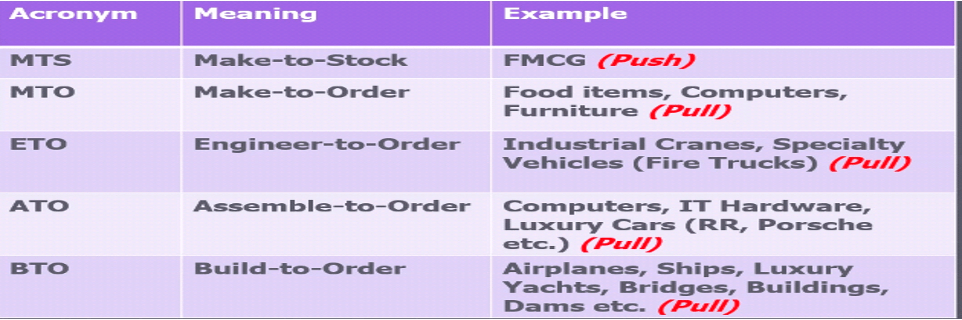
Push versus pull strategy:
Production approximation
Anticipated usage
Large lots
High inventories
Waste
Cash flow: when you’re able to accelerate you are trying to be as quick and as prompt with respect to the money. When you’re postponing the payment to the suppliers, it means you doing business with others money.
What are the data points that are needed to write and read and analyse the data to bring out insights wait time is a constraint?
Supply chain drivers and obstacles
Drivers of supply chain performance
A framework of
Facilities: places where inventory is stored, similar or fabricated. It is the production sites and storage sites. Inventory
It is concerned with raw materials, WIP, Finnish goods within a supply chain. Inventory policies: what kind of materials to stock, how much maximum quantity to stock to avoid overstocking and also to have enough raw materials to issued for production.
Efficient supply chains are able to deliver products at a low cost, while responsive supply chains are capable of responding quickly to changing consumer needs.
 Data Centric