How many authors, how many top authors from total, how many countries, what is connection between two authors, who are more outcome based, which are more institutions associated with research basis.
From broad area of research to narrower research towards quality national introduction.
Alan Pritchard 1969 coined the term.
“The application of mathematics and statistical methods to books and other media of communication”
“The statistical analysis of books, articles, or other publications to measure the output of individuals/research teams, institutions and countries to identify national and international networks, and to map the development of new(multi-disciplinary) fields of science and technology.” By OECD Glossary of Statistical Terms.
Bibliometrics can study literature for its content, utilisation of data, representation of theme, growth over time. It is the statistical Analytics.
Challenges in publications.
If something is published in cyber security challenges how many people have used it. Is the research shareable, who are the top contributors in the research study.
Who’s research and various sub topics of research. Countermeasures, control mechanism, etc. tehet could be different layers.
Great contributors in area and collaborate with them. If you don’t have much expertise in particular area.
Identify journals in which to publish. Which journal has scope and based on the quality of work.
Where is the gap available? Which area is not addressed much.
Why is it bibliometrics important? There needs to be an impact of your research outputs when applying for jobs, promotions or research fund is globally and nationally.
To identify the challenging areas in vast topics.
Where to search?
- Web of science : well accepted journal.
- Scopus** : affliation wise (name of institution), year wise. Abstract, title and journal. It is well accepted journal.
- Dimensions : Policy type, grant information, publications, patents, Clinical trials.
- Google scholar** : For a particular authors what are list of publications, how many people have refered to the manuscript, link to the actual publications, open source pdf and documents.
- SciVal : Quick access for understanding the research performance. What is the impact of particular reader how areas, funding applications possible, multi disciplinary.
- Incites: How many people refer to the publications. 10 people refer to the document there will be 10 citations. Assessing the impact is done through citations. For benchmark.
- Journal Citation Reports : Someone else has refered to the manuscript. It gives statistics based o
- It tells the impact factor. Impact factor is how far the research is impacting. How many of those manuscript are actually useful to community. Is it a high end journal or new journal.
- Scimago Journal and Country Rank
Why is bibliometrics important?
To identify the scientific productivity. If Fraud Analytics is what people researching on, are there patents in it, has someone worked in this direction?
Coverage aspect : During what period is it considered. Cloud computing and Deep Learning recently came so no need to study 50-60 years back. If psychology of students or psychology of students needs to be done it needs more years. It means years and resources for research like grey literature (available in internet like articles, blogs etc),
Accuracy of data : Authetication of sources. It is not sure with grey literature.
Topic identification.
Freeze the data study like Google scholar and Scopus.
Sub-area in the topic. Example : Machine learning has unsupervised, deep, supervised learning and reinforced learning.
Bibliometrics can be further limited to citations. If 5 publications with atleast 5 citations, the H index will be 5.
- CiteScore : The average number of citations received in a calendar year by all the items published in the journal in proceeding 3 years.
- SCImage : where the journal stands.
- Scopus SNIP : Specific to scopus.
Details extracted from search databases :
- Origin : Institute, country, language
- Source : Journals, publisher, classes
- Number of citations received
- Year of publications
- Year of citations received
- Number of authors contributing to the publication
- Subject category to which the journal belongs
https://www.sciencedirect.com/topics/computer-science/bibliometric-study
Manuscript : 5000-7000 words in depth to the topic.
| Old | New | Existence |
| Predictive Analytics | 50-60 years | |
| Corona Virus | Late 2019 |
For Scopus :

3rd September after 23 min
VOSViewer
VOSViewer manual
Step :
- TITLE-ABS-KEY(“Broad Topic” AND “sub-topic” OR “sub-topi” OR “sub-topic” ) AND (LIMIT-TO(DOCTYPE,”cp”) OR LIMIT-TO(DOCTYPE,”ar”)) AND ((LIMIT-TO(LANGUAGE,”English”))
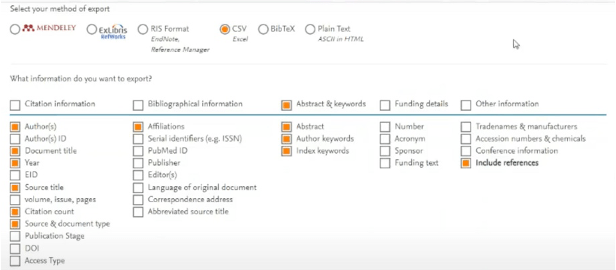
What is bibliometrics?
- Download .csv file
Literature review is expected to be neutral. Hence, bibliometric literature review along with systematic literature review avoids the personal bias that may be likely in the process of finding gaps in the extant literature survey. Espousal position thus researchers (undesirable) inclination towards some belief, ideology, prejudice, preconceived notion, affiliation etc.
“the reviewer of the literature has a position regarding the literature review itself.” –Cooper H. M.
Which means as an example shopclues is going down compared to Amazon, Flipkart and I may be biased thinking Lack of marketing(Perspective-Espousal) but data/final analysis may show with low customer satisfaction,low standard E-website development etc ..
Systematic literature review
Research : Understanding of a phenomenon and behaviour. Explore in and out of the behaviour. What the problem exactly is? Ask questions or define questions for the problem. Have sub-problems from big problems. Each question must consider a problem. There can be one or more questions but not repetitive.
Read new concepts. Don’t divert from the problem. Method of providing the answers with the scientific principles.
What’s the difference between systematic literature review and descriptive literature review.
What are the outcomes of systematic literature review.
How organisations adopt technology. Identifying relationship, consistancy and gaps. It helps to know what happens in past. What kind of directions can we give to future we can give to researchers. Dimensions geographical based, technology, etc.
What kind of research questions be there?
What effect does social media have on the attention span?
Systematic Research
Different types of depression
What they have said about future directions in literature review
Sampling
Internet Sampling :
Ethics in research
International Research
We cannot collect
If you don’t do non-sampling what kind of error will it generate ? Risk related feelings of people in the city
If you go for no sampling strategy
The sampling design process what do we do
Define the target population: all elements of interest to the researcher for that particular research study.
Determine the sampling frame: The word frame is generally used when we can list all the possible elements of interest from where we will draw the sample. The sample frame is actually larger than the sample. Survey for cleaning agents of household. In any household whether cleaning agents are to be used that’s the target population.
The cleaning agent is purchased by this customer is considered as sampling frame, it can also be the target population. The person who is using the cleaning agent is the participant of the survey.
We can use the word participants, respondents, elements, subjects or cases. Every case becomes one individual response.
If you’re dealing with experiment then you’re dealing with respondents but if you are
you are dealing with respondents.
Selected sampling technique:
Determine the sample size:
Execute the sampling process:
Define the target population
The target population is the collection of elements objects that possessed information sought by the researcher and about which inferences are to be made. The target population should be defined in terms of elements, sampling units, extent, and time.
An element is the object about which from which the information is desired example the respondent.
A sampling unit is an element, a unit containing the element that is available for selection at some stage of the sampling process.
Extent refers to the geographic boundaries. Are we willing to do the servant city area or semi urban area or rural area to see how the cleaning agent is used by the households.
Time is the time period under consideration. Some things become extent with time or highlighted with time for example we have to do survey related to COVID. What happens to the mindset of the academic development of pupils who have parents separated.
Define the target population
- The importance of the decision: The decisions are of theoretical and implementation of policy formulation for amendment.
- nature of research: Maybe the research is majorly quantitative or qualitative. Life processes happening in industries are more objective what are this or that. But if the research is not focusing on the elements but are kind of interpreted type or which are deploying the human objects accordingly the target population will change. Is it a mix method? Is it a completely exploratory study, description study, correlation study, number of variables.
- nature of study: What form the data is collected? Is it due to comparative rating skills or is it you do one rating skills. The target population might not have the information about the variables you trying to find the information about.
- nature of analysis: Is it qualitative or quantitative.
- Sample size used in similar studies: The greater the sample size the more funding it has by government organisations.
- What is the incidence rate: are the people you are both willing to give the information?
- Completion rate: if you circulate 5000 forms how many were actually filled by people. Maybe the completion rate is just 20% In Internet Sir very completion rate is much less.
- Resource constraints: we cannot step out and go to the door to collect the data. We cannot employ fieldwork agency because that will come with a very high cost. We cannot rent the field workers because such workers may not be available to us.
Sometimes you might have to change the subject for research but don’t change the question of research.
Research topic:
- What are the significance of medical devices for anaemic pregnant women.
- How did the demonetisation effect the digital currency
- Education related to hygiene of rural school going females.
Sample size used in research studies
| Type of study | Minimum size | Typical range |
Classification of sampling techniques
- Probability sampling techniques a time consuming and cost consuming.
- New researchers go with non-probability sampling technique .
Convenient sampling: It attempts to contain a sample of convenience. Often the fondant of because they happened to be in the right place at the right time. It is less expensive, time-consuming but most convenient. It is selection bias, non-representative and not for descriptive or casual research.
Use of students, and members of social organisations.
Small intercept interviews without qualifying the respondents.
Departmental stores using charges account less.
People on the street interviews.
It is not random.
Research topic:
- People of old age group usually attend the meditation programmes by going to the temple.
We need to understand are they really representing the larger sample.
Someone going home to home to survey for the accidents come on the convenience sampling because he can’t go to the bus drivers or the drivers.
Judgemental sampling: The sampling of based on the selection of the judgement.
Test marks
The researcher consist group B, C and ETA beautiful and convenient. But in each of these groups one or two elements are selected based on topicality and convenience. The resulting sample consisted of elements eight, 10, 11, 13 and 24. Note no elements are selected from groups a and D.
Quota sampling: there is a control variable category. He will classify people into male or female. Then he will classify the people according to the education level. Then he would classify the people according to vulnerable drivers and non-vulnerable people. The most wonderful people hours the motor vehicle people. Quota can be identified in different ways. Age group is also a quota. People who are concerned about environment and the road use use motor bike so they are also vulnerable. People who don’t have the budget to buy a car go with bike so they are the vulnerable users.
Can we combine quota sampling with convenient sampling?
We can collect the sample at the first place to the data and laces and understand the strength of the model and then at few more respondents so this trend becomes more strong according to the required project.
There are three ULB is operating in Pune city like Pune municipal Corporation, Pimpri municipal corporation or can’t you municipal Corporation
8 to 10 people daily communicate out of the city or inside the city
There was 10% floating population.
They decided to go according to the gender
According to the education or Road use practises or marital status
It’s not a representative population.
If your sample is representing this a population if not the larger population you can do cluster analysis and say that if the model of the results are not valid for the larger population they are at least valid for sub-population.
Every quota should represent the sub population effectively.
Snowball sampling: an initial group of respondents is selected usually at random.
After being interviewed, these respondents are asked to identify others who belong to the target population of interest.
Subsequent respondents are selected based on the reference. Can is to meet rare characteristics
This is time consuming.
These are very small samples but they give very selected test in the results of sampling which is generally not found in the literature.
This is usually taken in Reiki, spiritual practises or musical teachers, et cetera.
Usually consultants are participating in snowball sampling.
Simple random sampling with replacement:
Simple random sampling without replacement:
each element in the population has known an equal probability of selection. It is possible sample of a given size has and is known an equal probability of being the sample actually selected. This implies that every element is selected independently of every other element. It is easy to understand, predictable results. It is difficult to conduct sampling frame, expensive, low precision and assurance to representativeness.
The population size is finite or infinite.
We need to know the complete sampling frame.
Suppose they is a population of 100 and the sample size is 10 so the number of samples that can be drawn is 100 C 10.
People in social research area don’t rely on simple random sampling.
Ministry of Road and transportation Highway.
Hyderabad, Indore Surat population is similar to Pune as vehicle
What is the critical review and how do we write critical review of an article?
What is Data Science trained and how does the organisation culture impact they did a sign in enablement in the organisation. How can we be precise and yet all encompassing? The content has to be crisp, to the point and to identify the critical area where the research has to be confined. The research has to be one page to 2 page maximum and it has took campus the entire structure of the research and the content.
To write a critical review of an article one needs to understand the research methodological like qualitative quantitative or sampling, sampling frames or a bit of understanding of hypothesis.
What is expected from assignment 3?
How is critical review written from an article. Go to part 3. Part 3 needs critical review from future research purpose. Choose 1 research paper from the research portal. Based on the inclusion criteria in part two among the paper which has completely met the requirement of the systematic literature requirement. Choose that and write on it. Take out the value out of the research article. What are the limitations? What are the practises? What can you do in the future? Critical review means summarizing an idea. But how do we go about it. There are sequential steps or sub steps.
What is a critical review?
A critical review is much more than a simple summary, it is an analysis and evaluation of a book, article, or other medium. Writing a good critical review requires that you understand the material, and that you know how to analyse and evaluate that material using appropriate criteria.
Steps to writing an effective critical review:
- Reading: skim the whole text to determine the overall thesis (view or opinion), structure and methodology. International Journal of production research for industry 4.0. Is the context while date it in different contacts. What can the content be generalized to different parameters like to graphically, etc. Agreeing to disagree on certain deliberations. What is the structure and low of paper. What the author is trying to convey and portray. To what extent it is actually relevant. In what way the content in the article is going to be applicable in the research in different dimension in future.
As the author used a very profound theory. Types of reasons to support the conclusion. Theoretical framework: applying the particular theory. Don’t be stingy but be opened and be abundant. Take notes. If the line is written at the start but not proven at the end of the article.
- Analysing: it is not enough to simply understand what the author is saying; it is essential to challenge it. Examine all the elements. All aspects of the text – structured, the methods, the reasons and evidence, to conclusions, and, specially, to logical connections between all of these – ask a lot of questions! The type of questions asked will vary depending on the discipline in which you are writing, but the following samples will help provide a good starting point.
- Structure: what type of tax it is? (Four example: is it a primary source of secondary source? Is it original research or comment on original research?) What are the different sections and how do they fit together? Are there any section is particularly effective (or ineffective)?
- Methodology: is the research quantitative or qualitative? Does the methodology have any weakness? How does the design of structure study address the hypothesis? Are the hypothesis properly stated? Other hypothesis properly stating the research objective? What was the hypothesis is trying to motivate us whether to or not results are. Supporting or not supporting the hypothesis.
- Reason/evidence: what sources does the author use (interviews, Priya reviewed journals, government reports, newspapers, annual reports, etc. Close bracket? What types of reason unemployed (Inducted, deducted, abductors)? What type of evidence is provided (empirical, statistically, logical, etc.)? Is there a fusion of different techniques that has not yet been tested. If there is a research on data science and there are certain algorithm is being used to techniques of machine learning being used then you will find is this technique is no will or not that much use but still the authors have attempted to use explore how the results can be accurate than the other traditional methods. Are there any cabs in the evidence. Have they properly stated that the US of the gaps which may not fulfil the research article. Or they could have done some comparative analysis of traditional methods of algorithms. If competitive analysis would have been done it would have been much more useful for the users to understand the algorithm of machine learning. Are there any jobs in the evidence (or reasoning)? In objective reasoning go ahead with in complete research and then completed.
- Logic: what assumptions states the author make? Does the author account for all of the data, or or portions left out? It’s not backed up by thorough literature or they are not up to date with what is happening in the world. What alternative perspective remain and considered? Are there any logical flaws in the construction of the argument
- Conclusions: Does the data adequately support the conclusion drawn by the researchers? Or other interpretations possible? Are the conclusions dependent on a particular theoretical formulation? What does the work contribute to the field
- Writing: formulate a thesis based on your overall evaluation. A strong thesis will acknowledge both strengths and limitations. Choose a structure that will best love you to support your thesis within the required page constraints. Start with introduction and write overview of the article and then start evaluating the article. Stock market predictions have been impacted by traditional statistical methods which are machine learning algorithms by taking examples from different stock market price indexes across the worlds.
The article cites several different studies in support of the argument that playing violent video games can have a positive impact on students event. The studies refer to the educational games and other types of computer use. The argument is not logically well constructed. Education games are not the same as violent video games. The article also ignores data indicating that people with the highest CGPA are those that reported low computer use. Also different types of computer use could include things like researching a word processing, and these activities are very different from playing violent video games.
Better:
The evidence cited in the article does not support the overall conclusion that playing video game in through CGPA. One study only examines educational games in relation to CGPA, so it’s questionable whether the same findings will hold true for other types of games. Another study does not distinguish between different types of computer use, making it difficult to access whether it is game playing activities such as research in writing that contribute to improvements in GPA. Further the authorities relevant that indicates that student with the highest GPA or those who report low computer use, which means that a direct correlation between game playing and GPA cannot be supported.
Conceptual paper: theory building
Review paper: blue metric, systematic literature review, Meta analysis. Time can be spent on review paper.
Qualitative study: Case-based research, excellent research, grounded theory and ethnographic. If you are willing to spend quality time. What suppose you want to study the culture of a particular region so you will have to stay there and understand
Hypothesis driven: usually the people who come from technological background prefer hypothesis driven research.
Cross-sectional research paper and longitudinal research paper. It is only captured once and not asked again in 2 to 3 years.
Longitudinal study is the opposite of cross-sectional research. They can be applied in any management field but usually for the HR or marketing data studies.
How to creditability of data is there?
To provide theory to explain complex business operations.
To help bridge the wide care that exist between theory and practice.
To enhance the efficiency and the effectiveness of the business practises.
The research paper (quantitative)> review of literature > critical review of literature
Critical review of the literature: research question one (hypothesis option) close bracket, research question two (hypothesis optional)> definition of terms
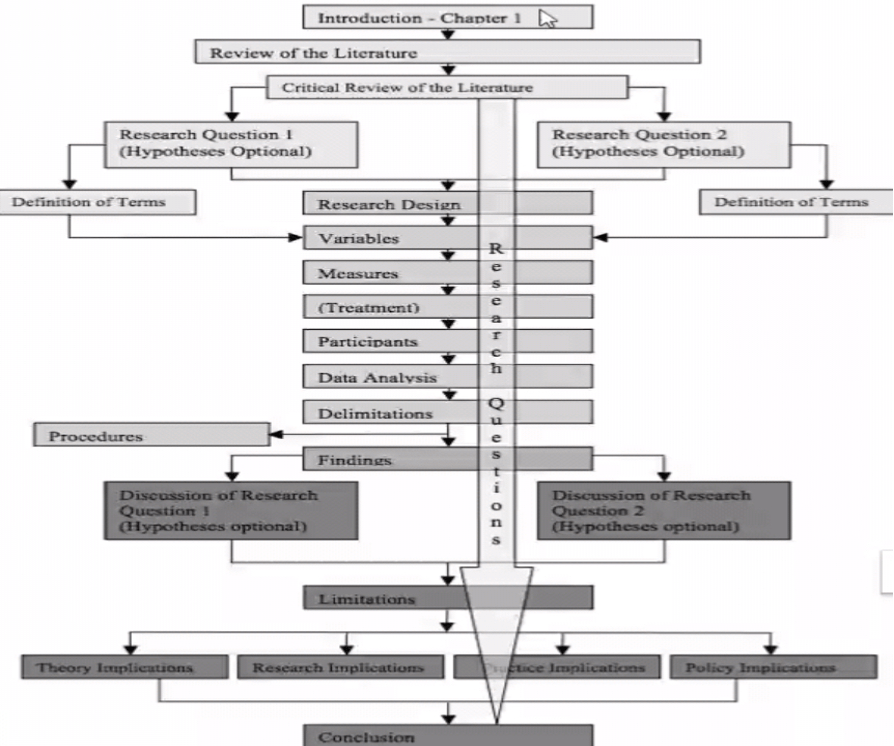
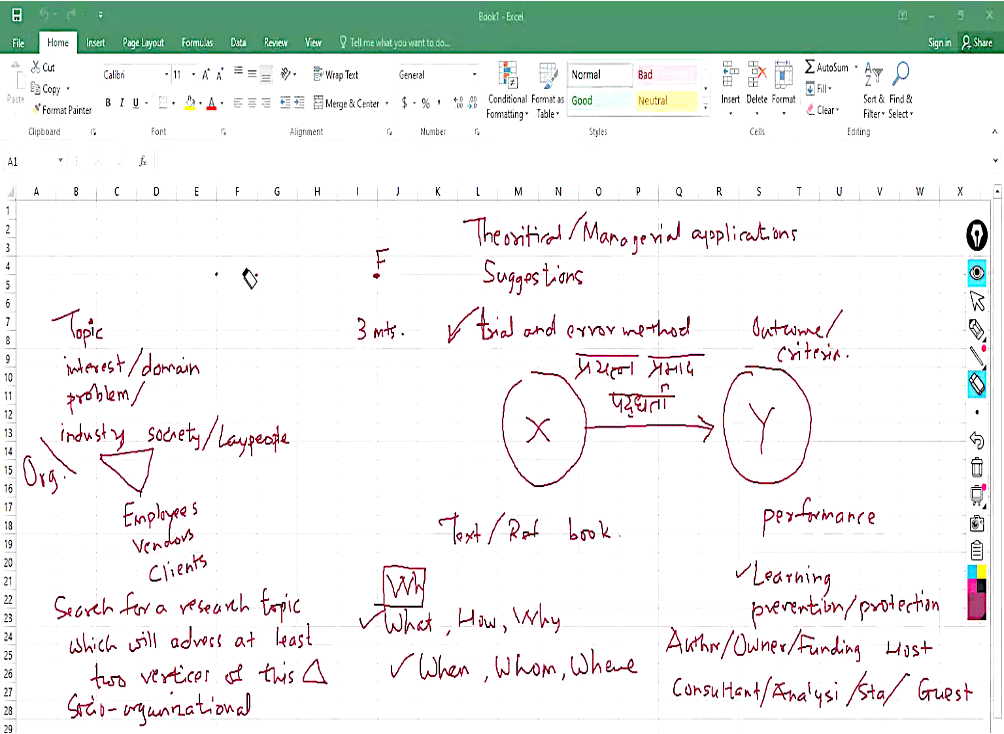
Tell about the significance of the literature.
Framework:
Logical structure that guides development of the study
Based on identification of key concepts and relationship between these concepts.
Concept name of the nominal or aspect of reality derived from observations made from pain on.
Example: job satisfaction/happiness/stress/behaviour intentions
Theoretical framework:
Theory – poet provides point to study/focus and unknown in specific areas.
Theory explain relationship between concept/wearable/Phenomenon.
Theories are purposely created/formulated by established researchers.
Theories can be tested
 Data Centric